Journey Library
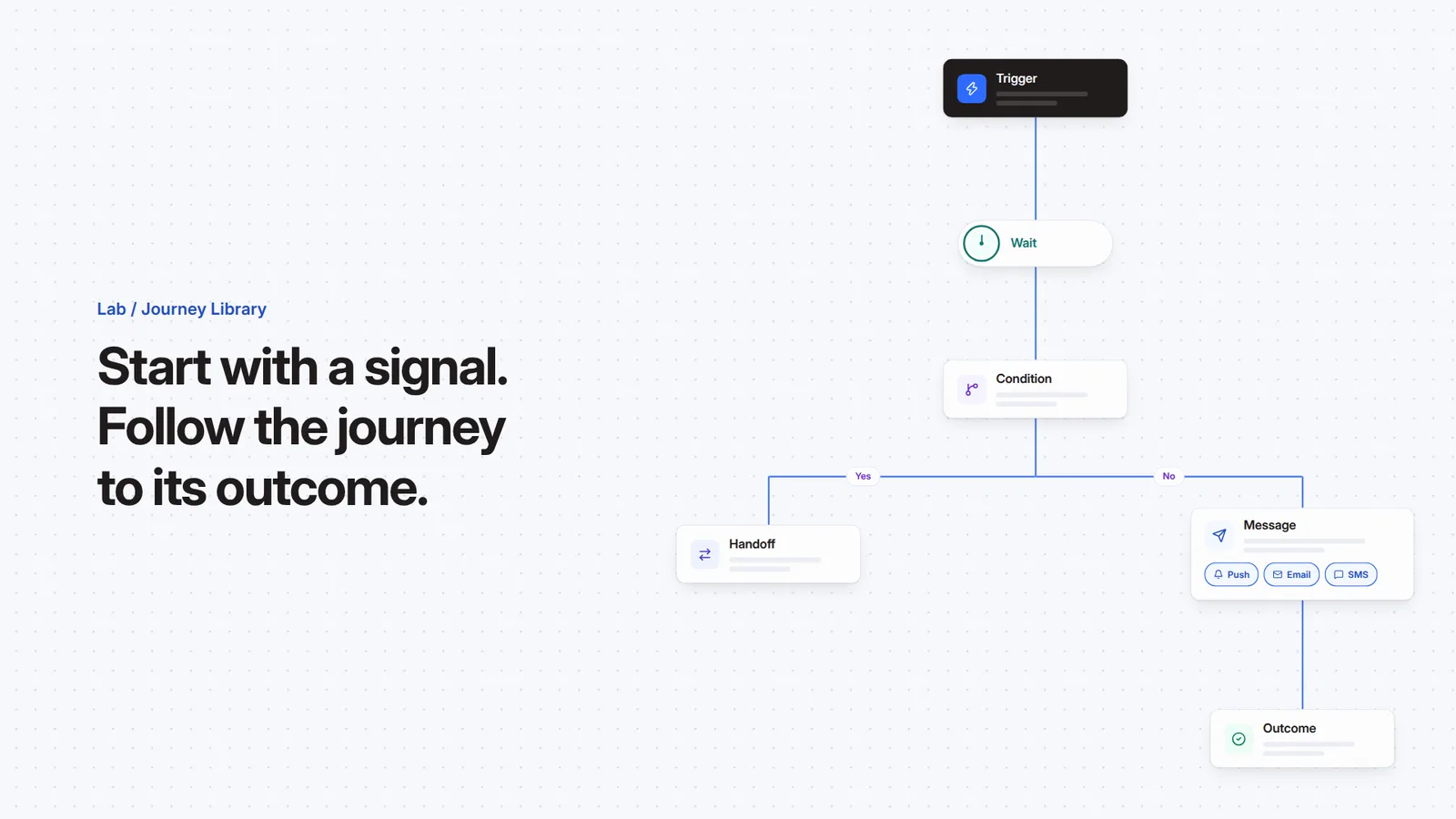
Start with a signal. Follow the journey to its outcome.
A practical reference library for lifecycle and CRM work. Every flow shows what starts it, where it waits or branches, which channel acts next, when another journey takes over and what stops the sequence.
- Behavior-led triggers
- Channel sequences
- Clear exits

- journeys
- 55journeys
- categories
- 7categories
- nodes
- 935nodes
- node types
- 6node types
Where to start
Start with the journeys that reach a customer.
Browse the flows by category, goal or channel, then open one to inspect its trigger, branches and outcome.
55
Customer journeys
Triggered flows that message a customer or route work to a team.
Largest journeys
The working model
A useful journey makes three things explicit: what starts it, who it affects and when it stops.
Triggers
Start only when the signal is strong enough.
Each trigger lists the evidence it needs and the lookalike signals that are too weak on their own. That keeps a journey from starting on a single ambiguous event.
Requires
- an authoritative record that one or more items were placed in a selection for this person
- the items, their current availability and current price as the platform asserts them
- the time of the last activity on the selection
Insufficient alone
- a product view - that is Unresolved Interest Recovery's subject
- an item added and removed inside the same session
- a selection already carried into a process - that is Abandoned Process Recovery's subject
- a selection whose every item the platform asserts as unavailable
Branching
Write both sides of every condition.
Every condition includes the path for people who match it and the path for people who don't. Both branches carry the rule that sends someone there, so no outcome is left implicit.
the identity resolves to a contactable person, at least one item is available, no process is open for the items, no instance is open for this selection, and commercial recovery permission is recorded
any of those fails - the reason is recorded as the no-action reason
Time
Give every wait a clear end.
Every wait states what event can end it, when it times out, what happens after either outcome, and whether new activity extends the window.
On event
On timeout
The first check waits a fixed span after the last selection activity - long enough that the person has actually left rather than paused - before it re-reads the selection. (example: 3 days)
a person still adding to a selection is not abandoning it; the clock runs from their last activity
The library
Open a journey and follow the decisions step by step.
The flows are organized around lifecycle problems rather than industries. Each one shows the trigger, decisions, timing, channel roles, exits and measurement plan without prescribing the message copy.
If this work overlaps with yours, let's talk.
Send me a note about growth, CRM, measurement or one of the projects here. A question, a counterpoint or a simple hello all work.